There is a lot of discussion out there regarding valve design and their effect on the performance of reciprocating compressors. Valve efficiency is often object of warm debates. Over the years I have seen several trials where the end user replace the existing valves expecting to improve the compressor capacity. Valve manufacturers quickly attribute any reduction in discharge temperature or increase in the flow to their product. And the end users tend to blame them when they don’t do so.
You may have seen promises of 10, 15 or even 20% flow increase by simply installing “high efficiency”valves…but, is this something feasible? The focus of this article is to outline what can and cannot be expected from the valves in terms of compressor capacity and some effective methods to estimate maximum expected figures by using very simple relationships.
So, let’s dive in.
Before going further we need first understand what the compressor capacity is and what parameters major affect that. Let’s start by examining the theoretical pV-diagram.

The swept volume is the total volume displaced by the piston during one complete stroke length. The inlet volume is the actual amount of gas brought into the compression chamber during the suction event, i.e. capacity! Capacity can also be viewed using the discharge perspective as the total amount of gas delivered to the discharge piping corresponding to the outlet volume. In a healthy cylinder with no leaks, it is expected to have the same mass of gas entering and exiting the cylinder. When the mass suctioned is compressed, at higher pressures, this same mass requires less volume and this is the reason the outlet volume shown in any pV-diagram is always smaller than the inlet volume.
How do we calculate the compressor capacity?
Assuming no leaks, the mass should remain constant. So we just need to calculate the mass of gas suctioned per compressor cycle. It can be shown that:


Where:
- Q is the compressor capacity or flow. Common mass basis units are kg/h or lbs/h. The most used volumetric basis units are Nm3/h and MMSCFD that in essence also represent mass over time.
- EVs is the suction volumetric efficiency.
- CL is cylinder Clearance Volume expressed as a percent of the Swept Volume (SV) – Figure 1.
- Operation condition (Blue): Suction pressure and temperatures (Ps, Ts), gas compressibility (Zs), isentropic gas exponent (k), compression ratio (r = Pd/Ps) and run speed (rpm).
- Compressor geometry (Green): Cylinder Bore (B), Stroke (S), Clearance Volume (CL).
- K is a constant that depends on the units of measure.
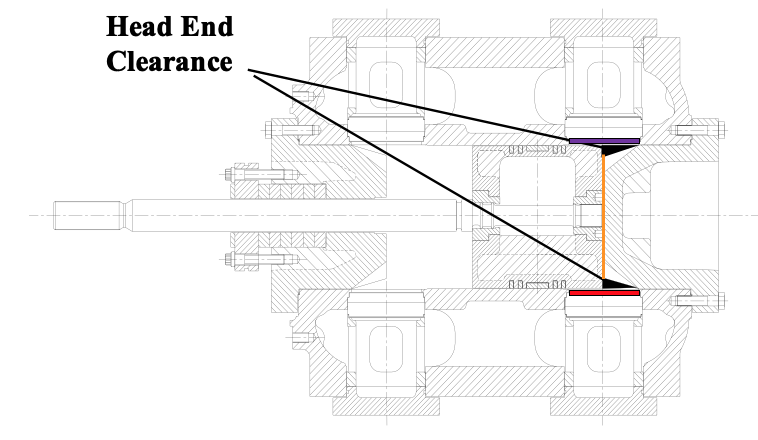
Figure 1. Double-Acting reciprocating compressor cylinder cross-section. Piston at Top Dead Center showing Head End clearance volume CL. Note Purple and Red are the suction and discharge valves clearance volumes. Source: Basic Thermodynamics of Reciprocating Compressors by Greg Phillippi.
You may wonder:
Where is the valve parameter in the flow equation ?!
The valves contribute whatever internal clearance is contained in the suction guard and discharge seat to the cylinder clearance CL. The valve clearance volume is the parameter that can be modified in the event of a valve replacement. Changes in the valve design can result in changes in flow based on the clearances added or removed by the valves involved.
How much change is expected ? Can we quantify that?
We can derive a function that compares the mass suctioned with an existing valve Set 1 and a proposed valve Set 2 and take the existing set as reference. In order to have a fair comparison as “apples to apples”, we need to assume the following:
- Healthy cylinder. No leaks.
- Tests will be done under the same operating condition.
- Tests will be done on the same cylinder geometry.
Keep all these three assumption in mind. We will need them later on.
The mass of gas with valve Set 1 (ms1) and valve Set 2 (ms2) are:

Now, let’s introduce two dimensionless variables. They are very handy when taking comparisons: c as the ratio between the cylinder clearance with the proposed and existing valve and lambda as a constant.

Note the following:
- The volumetric efficiency EVs cannot be negative nor above 1. So, the constant lambda is always positive and inside the range: 0 < lambda < 1.
- The total cylinder clearance CL1 and CL2 have been broken down into two parts:
- I) Cv1 and Cv2 are the suction and discharge valves clearance volumes of the Set 1 and Set 2 respectively.
- II) C is the cylinder clearance volume excluding the valves. This should remain constant since we are considering the same cylinder.
Thus, C can be defined as C = CL1 – Cv1. We can use this to rewrite c as:

Now, we can define q as the ratio of both capacities:

To make the equation prettier and to remove any bias quantity, let’s do the following:

Finally:


So, what is that mean?
The c’ represents the percent of clearance removed and q’ > 0 means a flow increase. Remember that lambda is always positive and between ]0, 1[, so for a flow increase c’ has to be greater than zero.
Let’s analyse the possibilities:
- c’ = 0 means nothing has been removed/changed so Cv2 = Cv1 and q’ = 0. No change in capacity.
- c’ = 1 means 100% of the clearance is removed so c = 0 and CL2 = 0. This is the maximum possible value for c’ and q’ represents a “maximum”. Note that this “maximum” is way too unrealistic since the condition of having zero clearance in a cylinder is near impossible.
- c’ has to lie in the range of 0 < c’ < 1 to get q’ > 0. So, for the capacity to increase the valve Set 2 has to add less clearance than valve Set 1, or Cv2 < Cv1.
- c’ < 0 means Cv2 > Cv1 and q’ < 0 so capacity decreases.
Let’s now plot q’ as a function of c’ for several compression ratios assuming CL1 = 15% and k = 1.29 – values typically encountered in a natural gas compressor. For simplicity, the plot only shows the positive values of q’ but it can easily be interpreted as an increase or decrease in capacity depending whether Cv2 > Cv1 or Cv2 < Cv1.
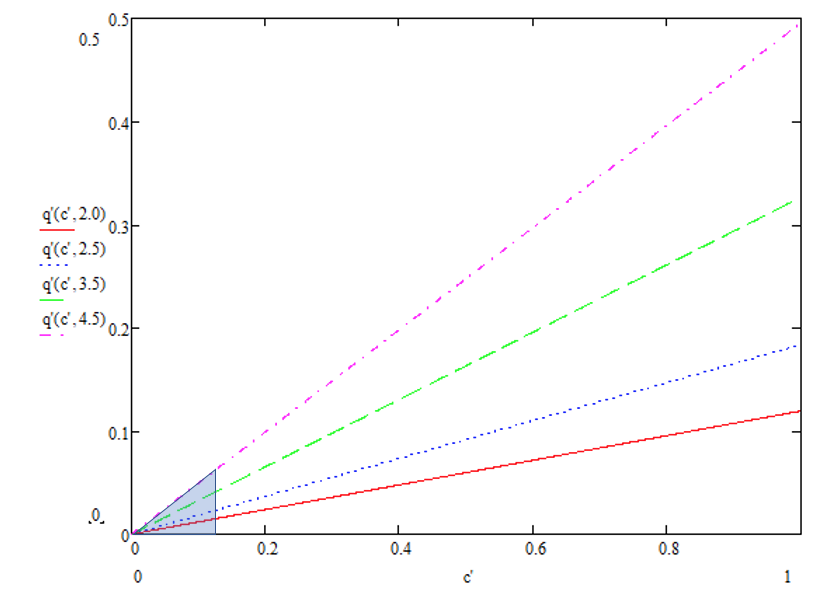
When replacing valves, is expected to have a slight change in the valve clearance volume (Cv2) compared with the existing valve (Cv1). Typical values of c’ are in the range of 0% to +/-10%. The shaded triangle above is showing that. For typical compression ratios of 2.5 (blue line) and 3.5 (green line) the flow change q’ represents +/-1.8% to +/-3.2% respectively. Changes in the clearance can be even higher especially in cases where the valve type involved is drastically different. For example, replacing a plate valve by a poppet valve or in cases where the new valve is thicker than the original. Poppet valves usually carry higher clearance so it is expected to have a higher value of c’.
What would be the maximum theoretical flow increase?!
A better way to determine the maximum theoretical flow increase rather than assuming CL2 = 0 is making Cv2 = 0 i.e. the proposed suction and discharge valve Set 2 adds no clearance. Of course this is hypothetical but helps us to quantify how much that maximum would be in an ideal situation. At this point c’ = c’max:


Therefore, q’max depends pretty much on the initial valve Set 1 and how much Cv1represents in relation to the cylinder clearance volume CL1. The larger Cv1 the higher the potential for flow changes. Most OEMs tend to design cylinders in such a way that the valve clearance volume takes only a small portion of the total cylinder clearance. Typically values of c’max are in the range of 5% to 15%. There are indeed cylinders where the valve clearance plays the majority, but it is not common.
Looking at the same plot above, for example, we can see that in order to have 20% increase in capacity (q’ = 0.2) at 4.5 compression ratio (pink line) c’ should be something around 40%. In a cylinder where c’max is 15%, the 20% flow increase become something impossible to reach.
But, what happens when the flow is visibly increased after certain valve is installed?
Easy one: if all the volumetric clearances has been assessed and the compressor flow is significantly higher than the expected maximum means that one or all of the three assumptions used in this analysis (remember them?) is invalid or the original valves were very poorly designed.
Let’s now dive in some of the most likely causes:
Leaking Valves
After the valve allows gas to enter or exit the cylinder and closes, it is essential that the sealing elements, rings, plate or poppets, present a satisfactory seal. If suction valves are leaking, gas will pass from the cylinder into the suction cavity during the compression and discharge events. If the discharge valves are leaking, gas from the discharge cavity will enter the cylinder during the expansion and suction events. This naturally increases gas recirculation and reduces capacity. The mass conservation is no longer valid. In many cases, during a valve assessment, the replaced valves are old and do not seal or operate properly. However, the new valves are in perfect condition and will result in a significant improvement in capacity and in most cases lower discharge temperatures regardless the type of valve used. It is common to atribute this flow increase to some type of “high efficiency design”. However any valve that simply seal and is well designed would led to the similar results. This is probably the most common cause of false flow improvements due to valve replacement. This can lead to erroneous conclusions if not analyzed correctly.
Late Closures
Conceptually, a valve that closes late is not leaking, but it has a similar effect on the compressor performance: reduces capacity. Late closures occurs when the sealing element do not close when the piston is at the top or bottom dead center. Thus, the valve element slams shut when the piston reverses direction and it is forced to close at impact speeds much higher than normal closings. This ultimately induce high transient stresses breaking plate/ring and springs causing leaks.
There are several causes for late closures. Springs too weak for the application do not have enough force to push the valve elements back to the seat causing it to close late and reducing capacity. Poorly designed springs end up broken by fatigue and leads to late closures as well. Contamination or excess oil in the cylinder also causes the “stiction” effect of the sealing elements, making it to abruptly close compromising the cylinder flow and valve realiability. Pressure pulsation inside the gas chamber can also cause unwanted effects on valve dynamics. This is more difficult to detect, but it can be done through special analyses.
High Valve Pressure Drops
Sometimes the springs used are way too heavy or the valve effective flow area (EFA) it too restrictive that they can delay valve opening resulting in reduced capacity. This can occur specially in low suction pressure or high speed cases. Heavy springs can also cause the valves to close very early, while there is still a significant pressure drop across the valve. This also reduces the cylinder flow.
Different Operation Conditions
It is very common to attribute false improvements to the valves when the compressor operates under different conditions. It is important to asses that to better understand the compressor behaviour. If the compressor is operating at a lower compression ratio with a recently new installed valves it is perfectly expected that the discharge temperature will decrease and the flow will increase. This occur due to changes in the operation condition and not the valves per se.
Another common situation occurs with old designed valves running in a condition that was not originally considered in the initial design. These valves usually do not operate properly and need to be optimised to the most recent operation condition. Any comparisons done against old designed valves chances are it will result in a flow improvement higher than maximum expected.
Conclusions
Capacity improvements higher than the maximum expected are most likely due to the presence of previous leaks, different operation conditions or poorly designed valves. Under these circumstances, any well designed valve will be able to significantly increment the flow. Therefore, compressor capacity is not a function of the valve type. Aerodynamic friendly or valves with high flow areas are not supposed to increase the compressor flow just because of the ring or plate geometry. So, unless the valves removed are leaking or very poorly designed there is little chance that only changing the valves can significantly change the cylinder capacity.
In order to significantly change the capacity the compression ratio has to be too high and the valve clearance volume needs to be significantly different from the existing one. Assuming no leaks, the same operation condition and a well-designed valve the scenarios where valve clearance contributes significantly to flow are very few.
A valve dynamics analysis and a spring dynamic stress simulation is essential for a good valve design. The valve lift and springing can be optimised during the design stage to ensure proper operation. This is also a very important topic I will (try to) talk about in my next article!
Stay tuned!